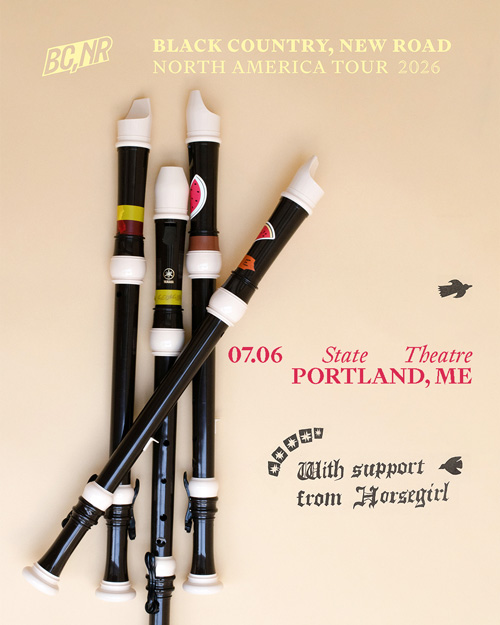
There are few contemporary bands who can do musical reinvention quite as consistently as Black Country, New Road. From their Mercury Music Prize-nominated debut For the First Time, which touched upon everything from jazz to post-rock via klezmer music, to the art-rock meets chamber pop follow up Ants From Up There (both top 5 charting albums). Then when singer Isaac Wood amicably left shortly after, they wrote an entire set of new songs to tour which ended up on Live at Bush Hall, an album The Guardian claimed was a “magical resurgence” in a triumphant five-star review. Now, on studio album three, the band are once again building from the ground up in yet another miraculous musical transformation. “Bush Hall was a really fun project to find our feet in,” says Charlie Wayne. “But we toured it to death and we were done with those songs. This album is a new statement of intent for us as a six-piece.” The band have now settled into a new shape in which vocal duties – and most of the songwriting – is split between Tyler Hyde, Georgia Ellery, and May Kershaw. “It created a real through line for the album, having three girls singing,” says Ellery. “It’s definitely very different to Ants From Up There, because of the female perspective – and the music we’ve made also compliments that.”
The band’s ability to respond to changing circumstances is not only down to their close-knit friendship but due to their talent, adaptability and long-standing relationship together as musicians. A mix of classically trained and self-taught, the multi-instrumentalists gathered steam as a band in the late 2010s, regularly playing The Windmill in Brixton alongside friends and peers such as Squid and Black Midi, and soon found themselves being labelled “the best band in the world” by The Quietus.
Despite moving swiftly on after each record, and never having conventionally toured in support of a studio album, the band’s fervent following has only grown and grown regardless. By the time they found themselves in front of an ecstatic audience to record their live album, they were singing songs that reflected on the profound friendship that had steered them this far through an unpredictable journey, as they hollered in unison: “look at what we did together / BC,NR, friends forever!” That deep-rooted attachment and connection are the foundations of their latest. And it’s also a hugely ambitious and singular record, which is glisteningly produced by James Ford (Fontaines D.C., Arctic Monkeys, Depeche Mode, Blur). “It’s pretty big and bold,” says Wayne. “There’s a lot of very full and rich creative decisions that went into it. Making this we were considering every single option and really opening up every possibility as we figured out how to operate in a totally different framework.” It’s a framework that includes everything from folk to prog via baroque pop and touches of alt rock – with nods to a variety of artists such as Joanna Newsom, Randy Newman, Fiona Apple and Janis Ian – yet all the while retaining that unmistakably unique sound that only this combination of musicians can come up with. Although hugely varied and expansive, the album also feels deeply cohesive and focused, as it takes three distinct voices and styles and seamlessly intersperses them into a new collective sound. “At the beginning, it was very random,” says Hyde. “We went in a few different directions just to see what we enjoyed and what happened but you soon realise how to chisel a certain sound or direction to sound cohesive.” However, while the band may have unconsciously been tapping into older reference points, everything about the album feels, both musically and lyrically, undeniably contemporary and fresh. The opening ‘Besties’ sets the tone for an album that is as accessible and melodic as it is nuanced and progressive. It’s a rousing yet delicate piece of chamber folk pop that is an ode to a particular kind of friendship. “It’s about creative flow, the importance of, and commitment to, female friendships in your twenties,” says Ellery. Musically, it’s something of a partner song, “a response” to following track ‘The Big Spin’ which was written by Kershaw and, explains Ellery, “was a song that just felt really easy going and so I kind of just ran with that same feeling.” With Hyde, Ellery, and Kershaw bringing individual songs to rehearsal sessions, what soon began to take shape was a kind of domino effect, with each person feeling inspired by one another’s songs and that in turn shaping their own. And so what quickly occurred was these three individual and unique talents, with distinct vocal styles, began to slowly coalesce to form a kind of intuitive songwriting relationship. “We play the songs through a lot,” explains Kershaw. “So after a rehearsal the songs would just be going around and around in my head. And things that are spinning around up there will come out in my songwriting, whether it’s conscious or not.” Hyde echoes this. “They’re just really good songs that get stuck in your head,” she says. “When I wrote ‘Happy Birthday’ I had Georgia’s song ‘Besties’ in my head while I was writing it. And therefore, the structure of it is heavily influenced by it.” ‘Happy Birthday’ being inspired by ‘Besties’ is a perfect example of how songs on the album are connected in spirit and tone but still feel like very standalone pieces of work. The former slowly builds over sprightly piano keys and laid-back guitar, with Hyde lyrically tapping into the frustrations of generational differences with younger people and their need to wake up from their own self-absorption, before it creeps into something quietly yet potently euphoric. Elsewhere there’s equally impressive range: ‘Two Horses’ grows from something that has an almost Americana meets dream pop feel into a propulsive and hypnotic folk-jazz-prog groove. ‘Nancy Tries to Take the Night’ has a Steve Reich-esque loop pulsing through it, while ‘Mary’ is a stripped back and tender track that beautifully and powerfully captures the three singers joining forces. However, while this is a record teeming with new ideas, instruments, voices and sounds, it works because the group also understands the importance of restraint. “We kept talking about The Band all the time,” says Hyde of the 1960s folk-rock outfit. “We haven’t made an album that sounds anything like them but I’m so grateful to them because they helped us play slower. We’ve tried to groove as much as possible on this album, to really sit back and make a conscious effort to not rush anything.” You can hear this in the slower approach to playing in parts too, as Luke Mark explains. “I’m trying to be a more mature musician and not be too excitable,” he says. “To try and make the song that someone brings in better, and not more about me. So that meant playing a lot more acoustic guitar to best serve the needs of the song.” Though, as Evans points out, when you have a group of musicians as talented as this bunch, even if you are stepping into bold new terrain and experimenting, there’s always going to be an inescapable identity to what they do. “Our musicianship is distinctive and characteristic,” he says. “So, no matter what the source material is, the way that we play with each other means it’s going to have a bit of a stamp on it. It is an individual sound.” This feeling of individualism sprouting into collective creativity is one that ultimately underpins the album. Evans recalls it being a beautiful thing to watch unfold and seeing the album find its stride and purpose. “The three of them just started to take more and more inspiration from each other’s writing,” he says. “And you could see their confidence grow.” Kershaw recalls that on the band’s debut album she “couldn’t even sing the backing vocals in front of everyone because it was too much.” And Mark recalls seeing a shift take place as faith and conviction grew. “The craft of the songwriting was so strong that it allowed their confidence as singers to blossom too,” he says. “It’s been cool to see not only the confidence grow but also the bravery to come up with new artistic ideas in such interesting ways.” Forever Howlong is an album that once again proves no records of theirs will ever sound the same, while also cementing the fact that there’s nobody coming even remotely close to making music that sounds like BC,NR right now.
We were kids, lined around the block; it was the summer of 2021 and Horsegirl was headlining Schubas Tavern. Our eyes were glowing and true as rockets of noise filled the room. There were legs and arms and bodies and hope and suddenly, there was a home for all of us, and we realized that this would be the hour from which our future sprung forth. Even from these early moments, Horsegirl possessed an honesty that has resonated with listeners. It is a spirit they have honored on their second album, Phonetics On and On, an exploration of the lines between pop, minimalism and playful experimentation.
There is something about the bitter cold in Chicago that unites the city in January— the two weeks in 2024 that Horsegirl spent recording Phonetics On and On were some of the coldest days in Chicago that year. With the heating off in The Loft to avoid sound interference, the band was bundled in multiple sweaters and sitting on their hands between takes. Working closely with musician/producer Cate Le Bon (Deerhunter, Kurt Vile, Wilco) Horsegirl found focus and intimacy in the studio that can only arise when it’s simply too cold to step outside. Abandoning the heavy saturation and character studies of Versions of Modern Performance, Le Bon leads them into new, bright, clear, sonic territories that highlight the inventive nature of these new songs.
After playing together for four years, Horsegirl explores the limits of the trio configuration within Phonetics On and On— what if instead of filling out songs with distortion, they utilized the expanse that the three of them didn’t occupy? This question seems to be the motivating force behind the record, and the songs are a testament to experimenting with space and texture while maintaining a pop song at the core. New tools help bring this world to life; violins, synths, and gamelan tiles are all woven into the record with complete effect.
One of my favorite moments of experimentation on the record is “2 4 6 8,” whose Raincoats-like violin parts and kinetic percussion elevate the song’s finale towards the same dynamic power of the Velvet Underground’s “Heroin.” The band relay that “2 4 6 8” was written almost entirely in the studio, as a result of Le Bon pushing them to lean entirely into the process of recording. It is an achieved byproduct of rewriting and rearranging, adding and subtracting, flash-moments of instability, and embracing the unexpected result. There’s also the album’s centerpiece “Julie,” whose synth drones become an ocean for Penelope’s vocals to sail above, all while Nora’s wonderfully avant-garde Rosa Yemen-like anti-solo’s pierce the woven sea.
Since their debut release in 2022, much has changed for the band. In the fall of that year, they relocated to New York City, where Penelope and Nora were to attend NYU. It was the first time the trio had written music outside of Penelope’s parents’ basement. You can hear the push in a new direction by virtue of their new environment, but through this time of unparalleled change, the band turns inward. They write with unanticipated honesty, leading us through scenes of girlhood and youth. Friends gathered around the kitchen table, smiling. Silent walks down cold streets as words freeze in air. Quiet mornings reading in bed with your partner sleeping beside you. The indelible truth is that Horsegirl is a band of best friends; being around them you can see that love in their eyes and it is always a joyous thing to witness.
It’s a love that is ever-present in Phonetics On and On. From the first seconds of “Where’d You Go?,” tenderness reverberates back and forth across the recording. Gigi’s dancing drum melodies and Penelope’s bright guitar leads direct your attention to the band’s chemistry and mastery of form. Horsegirl has the same playful rhythmic sensibilities of bands like The Feelies and Young Marble Giants, while still carving a path of their own. There is a confident simplicity to the songs of Phonetics On and On that brings the band’s songwriting ability to the forefront. These are songs to dance to.
Despite living in New York for the last three years, it was very important to the band to record their second album in Chicago. This is their home, both physically and sonically. Their music continues to blend with the adventurous Hallogallo music scene, which includes bands like Lifeguard (and their many side projects), TV Buddha, and Twin Coast. It’s a scene that prides itself on the pure collaboration of DIY culture, with its many house shows and zines. It’s an energy that is tangible in Phonetics On and On.
It’s hard to imagine any of these songs being written by anyone but Nora, Penelope, and Gigi. These are the moments of their lives. This truth arrives from the handmade core of the record, like a tapestry, or a journal; underlined, circled, and loved. Latching the door in place for all those who wish to follow.
-Eli Schmitt
Eli Schmitt is a long-time friend of Horsegirl, currently residing in Chicago. They are the editor of Unresolved fanzine, promoter of the New Now series of all-ages shows and YouTube channel, as well as a musician in multiple bands including TV Buddha and Post Office Winter.