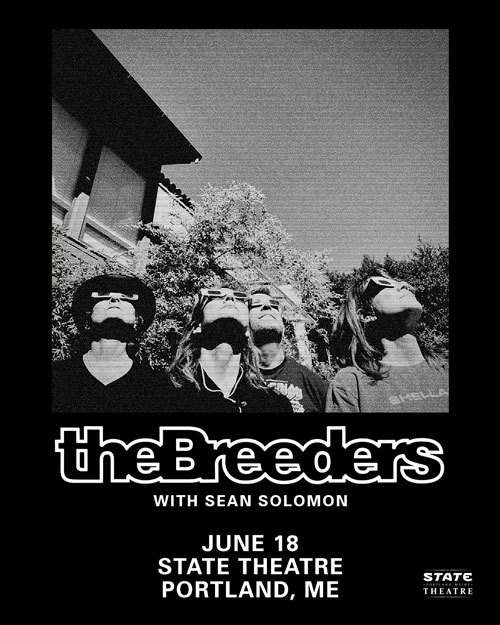
Kim Deal, Kelley Deal, Josephine Wiggs and Jim Macpherson played their first show together on Friday 19th June, 1992, in a snooker hall behind Warrington Rugby Club in the north of England. Two days later, they supported Nirvana in Dublin and Belfast, and then played at Glastonbury. Back in the US, after playing 27 sold-out shows, they made their way to San Francisco to record Last Splash.
Released on August 30th 1993, reviewers described Last Splash as, “effervescent,” “blistering,” and “incoherent.” At its centre is the infectiously appealing, instantly recognisable ‘Cannonball’. Propelled in part by the video directed by Kim Gordon and Spike Jonze, the song was voted Single Of The Year by NME. “An alt-rock classic” (Pitchfork’s Top 100 Records of 1990s) upon release, the album quickly attained Platinum status in the UK and the US.
Throughout Last Splash, The Breeders demonstrate their versatility and panache, seamlessly transitioning from the dreamy, melancholic melodies of “Do You Love Me Now” through the grungy, frenetic energy of “SOS,” to the downright creepy weirdness of “Mad Lucas.” Kim’s song-writing—with its authentic rebelliousness, atmospheric instrumentation, and playfully ironic lyrics—has the extraordinary ability to express the intangible, which, together with the undeniable talent and electric presence of Kelley, Josephine and Jim, created a powerful force of a band. It was also, in part, a family affair; as described by Kim, “here I was in Dayton, my sister in the band, my dad driving the RV on our first tour. My friend Jo. Jim from Dayton too. That’s what this album reminds me of — time spent with my family and friends.”
The raw energy of the album comes in part from spontaneity and experimental production techniques which give each track a unique sound. On ‘Cannonball’, in final rehearsals before recording, Josephine accidentally played the high note of the riff flat before correcting herself—a mistake which was incorporated into the song. To achieve the distorted vocal sound, Kim plugged her brother’s harmonica microphone into her Marshall. “There was quite a bit of feedback,” Kim recounts, “so I had to step in and out of the room to get just the right amount.” Kelley, anticipating possible downtime during the four-week recording session, brought her sewing machine to finish a quilt for her mother. Kim, hearing the whir of the machine, put a mic on it. “It’s the first sound you hear on S.O.S.—Zig-zag stitch” says Kelley, who gets an album credit for guitar, vocals, and Kenmore 12 Stitch. Kelley turned the Morse Code distress signal (▄ ▄ ▄ ▄▄▄ ▄▄▄ ▄▄▄ ▄ ▄ ▄) into a guitar part, hence the name of the song. To get a more abrasive guitar sound, the band built what Jim termed ‘the vortex’ – “using sheets of plywood we laid a floor and assembled walls and a roof to make a giant funnel, with Kim’s amp at the big end and a microphone at the small end.” The tremolo-effect on Jim’s drums was achieved by sending his ambient room tracks into a Leslie Rotary Speaker. (The Prodigy later sampled the guitar and drums for “Firestarter.”) On ‘Do You Love Me Now’, Kim sang into the strings of a grand piano, using a brick to hold down the sustain pedal, to create an eerie reverb from the resonating strings. Kelley remembers, too, Kim’s singular approach to problem solving, “She thought the cymbals sounded “too new,” they were ringing too long after Jim hit them. She wanted to fuck them up… I was in the studio lounge sewing, while Jim and Kim dropped cymbals out of the second-story window.”
The Breeder’s dynamic style and Kim’s moments of sheer chaos and excitement were also in evidence when they re-recorded ‘Saints’ for a single release. J Mascis, producing the session, recounts Kim “punching in vocal lines and running fifty yards across the whole church (aka Dreamland Studios) to the control room to listen, then running all the way back to do it again, back and forth, over and over again … I was exhausted just watching, she was pumped.”
Last Splash was mixed at the legendary Record Plant in Sausalito, a labyrinth of dark carpeted hallways hung with the gold and platinum records of Sly and the Family Stone, Stevie Wonder, Fleetwood Mac, and Jefferson Airplane. One morning, setting up a mix, the engineer accidentally erased the first 45 seconds of ‘Do You Love Me Now.’ Miraculously, a copy of the 2” tape had been made—mailed to Dinosaur Jr’s J Mascis with an invitation to overdub guitar on ‘Divine Hammer’—and the engineer was able to rebuild the missing part, a painstaking process (before digital recording) that took seven days.
The album’s artwork—as memorable as its sound—was devised by Vaughan Oliver, the creative force behind the distinctive visual aesthetic at 4AD Records. His sleeve for ‘Cannonball’ perfectly embodies the playfulness, irreverence, and idiosyncrasy of the Breeders. Josephine recalls Vaughan’s initial brainstorming, sent via fax – a drawing of “a man’s testicle, alone—pushed through a piece of card to ensure its loneliness.” “He said he had tried it out that morning and ‘thought it looked super’ and he thinks it’s never been done before—I can’t imagine why not (?!)”
A defining album of the 90s, Last Splash turns 30 this year. To celebrate, the record has been remastered for the first time, using the original ½ inch analog tape, lovingly worked on by Kim, Benjamin Mumphrey, and Miles Showell at Abbey Road. The tape, consisting of final mixes, but un-sequenced and unmastered, was only recently rediscovered in the Warner Bros. archive, a discovery that has made possible this ultimate audiophile vinyl pressing, and also brought to light two unreleased tracks from the 1993 Last Splash recording sessions, a bonus which will delight fans.
The album has never sounded so good. Titled “Last Splash (the 30th Anniversary Original Analog Edition), cut at half speed at Abbey Road, it now spans two 12” discs running at 45rpm. Also included is an exclusive one-sided etched 12” disc featuring the two “new” tracks: a song that Kim co-wrote with Black Francis titled ‘Go Man Go,’ and a different version of ‘Divine Hammer’ with lead vocals by J Mascis and titled, naturally enough, ‘Divine Mascis.’ For this special release, the late Vaughan Oliver’s iconic sleeve art has been gloriously reimagined by his long-time design partner Chris Bigg. A Japanese CD release will also be available.
Musician and animator Sean Solomon had great expectations. But when his hopes for an abundant world crashed against an unforgiving reality, he decided to feel nothing. For a time, the Los Angeles-born-and-raised singer/songwriter and cartoonist/animator gave into the void, but artistic expression can be a release valve – a way to comprehend the world and build community, which is exactly what Solomon does on his debut solo album ‘The World Is Not Good Enough’, arriving April 17 via his new label home of ANTI- Records.
The album art features Sean’s winking take on a Richard Scarry book cover and mirrors the cognitive dissonance that pervades the album, which seamlessly moves from bare-bones acoustic guitar to a Neutral Milk Hotel-esque cacophony of marching drums and horn blasts. “I was thinking about those books and how they show an idyllic version of the world,” Sean says. “I thought it was kind of funny — the contrast between the title and the images. Like, there’s a dog walking a dog on the back cover, an elephant drinking out of a coffee cup with its snout. It was fun to study these children’s books and think about what my version would be.”
Growing up in the San Fernando Valley, Solomon felt especially drawn to both music and animation and immersed himself in episodes of The Simpsons and illustrated stories by graphic novelist and Ghost World author Daniel Clowes. Meanwhile, Sean was an avid fan of seminal ‘90s and early 2000s punk and alternative acts such as Daniel Johnston, Elliott Smith and Nirvana, the latter of whom he admired for the way they preserved their artistic integrity in the face of global stardom. Adopting his own punk sensibility, Sean and his high school band, the folk-punk Moses Campbell, played all over LA, booking their own shows at coffee shops, houses, and famed DIY venue The Smell. This was followed by playing in the three-piece band Moaning who released two albums on Sub Pop.
After Moaning went on indefinite hiatus in 2023, Solomon thoughtfully wrote and recorded his first solo songs over the better part of two years, culminating in what would become ‘The World Is Not Good Enough’. The contemplative eight tracks feature fellow Sub Pop veteran and Sean’s former roommate Shannon Lay on backing vocals and guitar and producer Jarvis Taveniere (Whitney, Purple Mountains, Waxahatchee), who produced and stood in on bass and some percussion.
“Working with Sean felt brotherly,” says Taveniere. “We’re similar people; we can both lean into being neurotic or anxious, so it was fun to balance each other out … He was somebody who had a tight vision but let me be playful while also staying sensitive to the material.”
In addition to animating each video he releases, Solomon has also been cooking up comics with his lyrics in word balloons for each new song. He even drew his stage plot and tech rider by hand: “All the stuff that’s annoying about being a musician, I’m like, ‘How can I do this in a creative way so that it doesn’t feel like work, and it feels like something that’s inspired?’” So that he can integrate his animated visuals into his live shows, Solomon has lugged a vintage TV set armed with a VHS input to each venue, the animations and backing tracks running on tape being the only bandmates he shares the stage with.